Appliance and Supply Hose Leaks in Lindenwold, NJ
Washer, dishwasher and refrigerator leaks soak floors and cabinets before they show. The drying crew maps where the water went, removes what cannot dry and dries the rest to readings.
(888) 471-9821Lindenwold appliance leak help- Hidden moisture mapped
- Cabinets and floors dried
- Hose failures documented
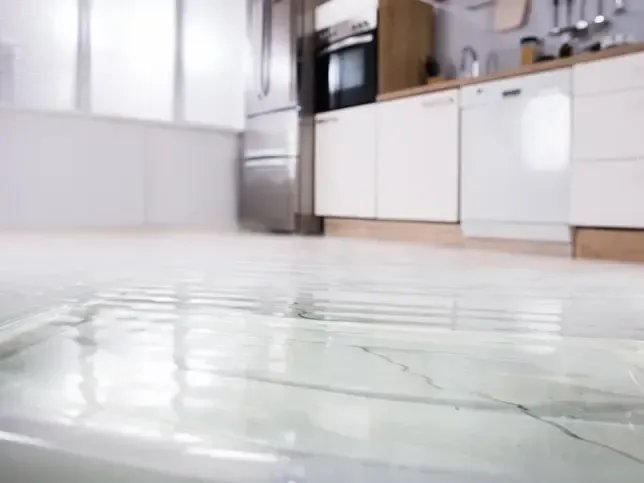
First moves for appliance and supply hose leaks
- 1
Shut off the supply
Close the valve behind the appliance, or the main valve if it is hard to reach.
- 2
Unplug only if dry
Pull the plug only if the outlet and floor are completely dry, otherwise switch off the breaker.
- 3
Pull it forward
Slide the appliance out carefully so the wet floor and wall behind it can be seen.
- 4
Photograph the leak
Capture the hose, the fitting and the damaged flooring before cleanup.
How appliance and supply hose leaks is handled in Lindenwold, NJ
Each step follows the IICRC S500 drying standard and leaves a record for the claim file.
- 1
Find the source
Meters and a thermal camera trace the leak from the hose or fitting to every wet surface.
- 2
Extract and open
Water is removed and toe kicks or flooring are lifted to expose wet areas.
- 3
Dry the cavities
Air movers and dehumidifiers run until the readings flatten.
- 4
Document the leak
Photos and logs are kept for the appliance repair and the claim.
What does appliance and supply hose leaks cost in Lindenwold, NJ?
Appliance leaks vary with how long they ran. A laundry area caught fast costs little, while a slow leak that soaked cabinets and a floor below needs more removal and longer drying, and the repair is billed separately.
Laundry area, found fast
$1,000 to $3,000
- Water extracted
- Floor dried in place
- Readings each visit
Kitchen cabinets and floor
$3,000 to $7,000
- Toe kicks removed
- Cabinet bases dried
- Flooring lifted
Slow leak, two levels
$7,000 to $14,000+
- Ceiling below opened
- Subfloor dried
- Longer dehumidifier run
Ranges move with the water category, the square footage, the material class and how fast drying started. For a planning number, run the water damage cost calculator.
Most appliance leaks are slow. A cracked hose behind a washer or a loose fitting under a dishwasher can drip for days, wetting the floor underneath and the cabinet bases beside it before a stain appears. The hose may look fine from the front, because the wet spot sits behind or beneath the unit.
Where the water hides
Water from a kitchen or laundry leak travels under flooring and into the bottoms of cabinets and walls. A floor that looks only damp on top can be soaked below, which is why meters are used instead of a quick look. Wood and laminate flooring swell along the seams when the water has been there a while, which is another sign the leak ran long.
- Toe kicks are removed to let air into cabinet bases.
- Flooring that has lifted or cupped is checked for moisture in the subfloor below it.
Apartments and shared walls
Apartment communities, such as those along Gibbsboro Road, are part of the housing here, and a hose leak in one unit can reach a neighbor's ceiling. In those buildings the crew checks adjoining units so the damage is not left behind.
- Readings below and beside the source unit show how far moisture traveled.
- Records from both units help when more than one claim is involved.
Drying, then the repair
Dehumidifiers and air movers dry the floor and cabinet cavities, and readings are logged each visit. A technician or plumber repairs or replaces the appliance or hose, and the drying crew documents the leak for the file.
If the leak ran long enough to stain a ceiling, the ceiling leak page shows how that stage is handled. Across the borough, the same crews cover leaks and floods of every size, from a loose hose to storm water.
Appliance and supply hose leaks across Lindenwold and nearby towns
Appliance leak calls come from houses and apartment communities across Lindenwold, including the Gibbsboro Road corridor and the streets around Linden Avenue, Kirkwood and Lucastown, wherever a hose or fitting gave way.
The same service nearby: appliance and supply hose leaks in Marlton, Stratford, Somerdale.
Related water damage services in Lindenwold
Appliance and Supply Hose Leaks questions
Short, plain answers on appliance and supply hose leaks, from the first call to the last moisture reading.
Ask dispatch what happens nextWhy do hose leaks cause so much damage?
They are slow and hidden. Water seeps under flooring and into cabinet bases for days, so the wet area is usually much larger than the visible spot.
Can a washer or dishwasher leak reach the unit below?
Yes. In a multi-unit building the water can drip through the floor into the ceiling of the unit underneath, which is why neighboring units are checked.
Do cabinets have to be removed?
Often they can stay. Toe kicks come off so air reaches the base, and cabinets are removed only when readings show the cavity cannot dry.
Should I fix the appliance first?
Shut off the supply first, then call a plumber or technician for the repair. Drying should start right away rather than waiting for the repair.
Is the water from an appliance clean?
Supply water is usually clean, but wastewater from a washer or dishwasher drain can be contaminated, so the crew checks the source before choosing a method.
Dry the floor and cabinet bases
Describe the appliance and which floors or rooms look wet, and the crew will plan moisture mapping, removal and drying around the space.