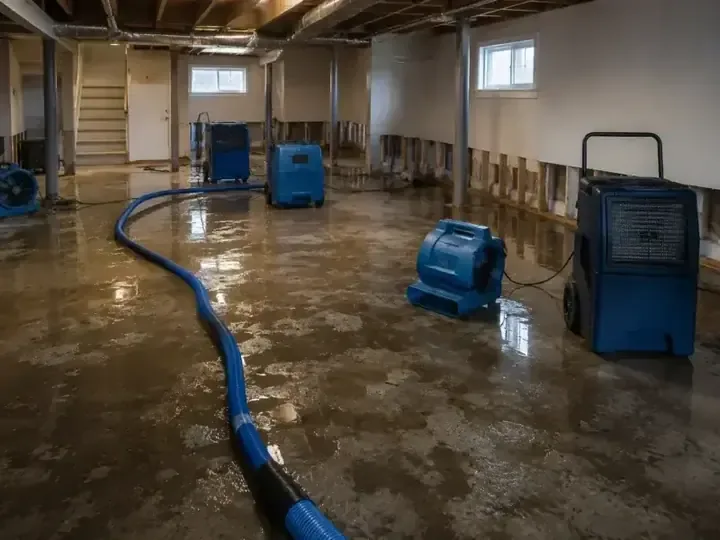
In late July 2025 a heavy downpour caused flash flooding in Somerdale. North Warwick Road went under water, and a woman was rescued from her flooded car, according to a report from 6abc on July 28, 2025. This post uses that storm to explain where the borough's storm water goes, why it is treated as flood water and what the first steps look like when it gets close to a door.
Key takeaways
- A heavy downpour in late July 2025 caused flash flooding here and flooded North Warwick Road.
- The borough says storm drains usually run directly into creeks, ponds and lakes, unlike sanitary drains, so storm water carries whatever the streets collect.
- Storm water that gets into a building is pulled out fast and handled as contaminated flood water, not as a clean spill.
- Cooper Creek follows the Red Fox Run trail, and the borough posts an outfall map and a stormwater plan that show how drainage is laid out.
- The sooner standing water is extracted, the less of it wicks into walls, trim and flooring.
What the late July 2025 downpour did
The storm was sudden. A heavy downpour put North Warwick Road under water, and a woman was rescued from her flooded car.
Flash flooding works that way. Roads fill faster than drivers expect, and a car that looks safe to cross can stall in moving water.
- Flooding started on a road, not on a river bank, so a creek reading would not have warned anyone.
- Vehicles were the first danger, which is why the weather service tells people not to drive through flood water.
- Water that reaches a doorstep can follow cracks, vents and door gaps into a building.
Where Somerdale's storm water goes
Public Works maintains public streets and rights of way, and that includes storm water drainage. The borough explains that storm drains usually run directly into creeks, ponds and lakes, unlike sanitary drains that carry household waste to a treatment system.
That means rain that runs off a street is not cleaned on the way. It carries what the street picked up: oil, trash, soil and animal waste.
- Cooper Creek follows the Red Fox Run trail out to White Horse Road, with public parking at Grant and South Browning Avenues.
- The borough posts a Municipal Stormwater Management Plan, stormwater ordinances, an outfall map and a page of current stormwater projects.
- Public Works splits the borough at Atlantic Avenue into an East Side and a West Side.
Why storm water is treated as flood water
Clean water from a broken supply pipe and storm water from a street are not the same job. Storm water that reaches a building is contaminated, so the crew treats it as flood water.
A storm and flash flood cleanup therefore removes more than a clean leak would. Porous materials that soaked, such as carpet, pad, insulation and low drywall, are usually taken out instead of dried.
- A burst supply pipe starts out as clean water, and it can often be dried in place when it is caught early.
- Storm water starts out contaminated, so soaked porous materials are removed.
- Hard surfaces, framing and solid trim are cleaned and treated, then dried to readings.
What water does once it is inside
Water does not stay where it lands. It moves into baseboards, wall bottoms and the subfloor, and it wicks upward into drywall and insulation.
A meter and a thermal camera find water that the eye cannot see, which is why the room looks dry long before it is.
Once the hidden water is mapped, structural drying with dehumidifiers and air movers brings wet framing and subfloor back to normal levels. Cutting out a strip of wet drywall is sometimes the only way to reach the cavity behind it.
- A musty smell in a room that looks dry.
- Baseboards that swell or pull away from the wall.
- Paint that bubbles or peels near the floor.
- Flooring that cups, buckles or lifts at the seams.
- Doors and trim that begin to stick.

When water is near the door
Not every flood event puts water inside. When it is close, the choices in the first stretch make a difference.
- Stay out of flowing water on the road, and never walk or drive through it.
- Move valuables, papers and electronics off the floor and up to shelves or higher rooms.
- Shut off power to flooded rooms only from a dry spot, and leave panel work to an electrician.
- Photograph the water level, with dates and times, inside and outside.
- Keep street drains clear of leaves where it is safe to do so.
How the extraction and drying work runs
The first step is water extraction. Pumps and extractors remove the standing water so it stops spreading into walls and subfloors.
After that, the team removes what cannot be saved, cleans and treats the hard surfaces and sets dehumidifiers and air movers. Moisture readings set the pace, and the equipment stays until the materials read dry.
Roads usually reopen long before a building is dry. The drying equipment keeps running after the street water is gone, because the structure holds water longer than the pavement does.
Speed matters
Wet drywall, pad and wood begin to break down quickly. Mold can start to grow within 24 to 48 hours, and storm water makes the case for fast removal stronger.
Documentation matters too
Photos, moisture readings and a list of removed materials give a clear record of what the storm did and what the cleanup did in response.
Getting ready before the next downpour
No one can prevent a storm like the one in late July 2025, but a few habits cut the damage.
Preparing costs little compared with a flooded room, and the same habits help in any heavy summer storm.
Local water damage experts can talk through a plan for a specific building before the next storm, so the steps are already known when the water rises.
- Know which routes flood first, and plan another way out.
- Keep sandbags, plastic sheeting and a flashlight where they are easy to reach.
- Store boxes, tools and electronics on shelves instead of the floor in low rooms.
- Look at the borough's outfall map and stormwater plan to see how local drainage connects.
Questions
What happened in Somerdale in late July 2025?
A heavy downpour caused flash flooding. North Warwick Road flooded and a woman was rescued from her flooded car.
Where do the borough's storm drains empty?
The borough says storm drains usually run directly into creeks, ponds and lakes, unlike sanitary drains.
Is storm water cleaned up like water from a broken pipe?
No. Storm water is contaminated, so the crew handles it as flood water. Porous materials that soaked are usually removed instead of dried, while hard surfaces are cleaned, treated and dried.
Which creek runs through the borough?
Cooper Creek follows the Red Fox Run trail out to White Horse Road, with public parking at Grant and South Browning Avenues.
Should extraction wait until the rain stops?
No. Once it is safe to enter, extraction starts right away, because standing water keeps wicking into walls, trim and flooring while it waits.
What are the warning signs that water is still inside a wall?
A musty smell, swollen baseboards, peeling paint near the floor and flooring that cups or lifts all point to hidden moisture. A meter and a thermal camera confirm it.